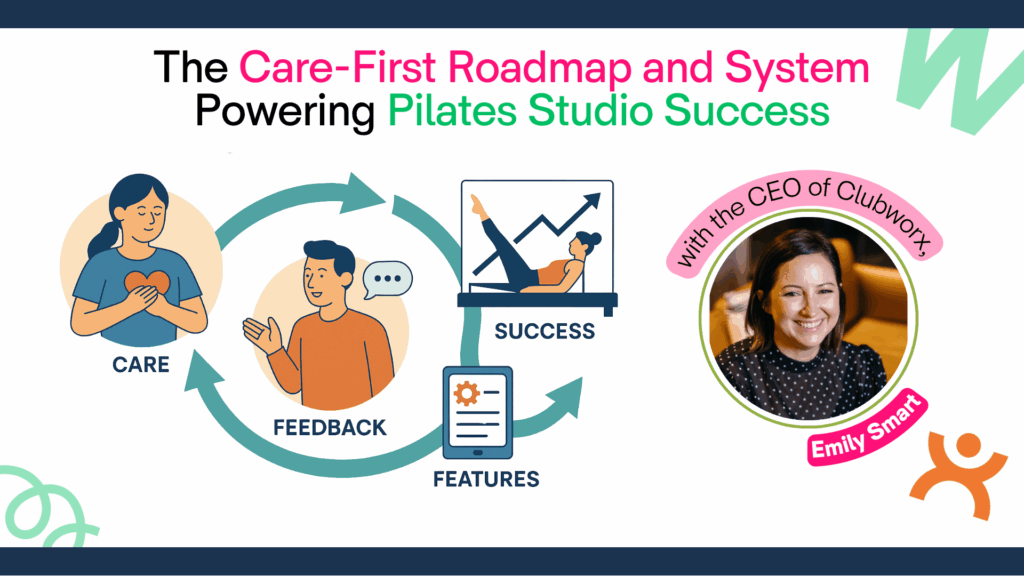
In this second episode of A Scheduling and Payment System that Cares, David Gunther continues his conversation with Emily, CEO of Clubworx, to uncover how a care-first mindset can drive real innovation in Pilates studio management.
Picking up from Episode 1; A Scheduling and Payment System That Cares, this discussion dives deeper into how the Club Worx team turns customer feedback into features that truly make a difference, from an evolving member app to an in-app store that gives clients new ways to connect and buy in real time.
David and Emily explore what happens when technology meets empathy, how care can shape every decision, every feature, and every relationship in your business.
 What You’ll Learn
Chapters
“Our product development roadmap is born of where we want the product to go, but it’s also very much mixed in with the feedback we’re constantly receiving from our customers.” — Emily Smart (Clubworx CEO)
If you’ve ever wondered how to make your systems work for you, not against you, this episode reveals how empathy and feedback can power both your technology and your business growth.
Stay tuned: Emily returns for the next episode in this series, where we’ll explore the essential reporting and payment tracking features every Pilates studio needs to improve profitability and free up more time to focus on what truly matters: your clients.
Episode Resources
David Gunther: I'll also never forget, our staff at that time, it's quite emotional for me, actually, at that time, we were thinking, because we're looking at a brick wall, we're thinking, we're done. This is it. we've got to look at, doing something else because, we're not going to live through this without business, but our online staff, our, remote staff, I remember them saying, we've got you.
We've got you. We're going to help you. And we're going to help you get through this. And they did. And just the dedication, not just the connection with the clientele, but the dedication of the staff, the instructors to do, semi private sessions where people have injuries and, Mobility concerns, and we're using cans of soup and different other things for weights
Chris: Pilates business owners, welcome to The Pilates Business Podcast, brought to you by the people who own, operate, and instruct in a successful clinical Pilates studio in Australia.
Our mission is to help you to discover Pilates business assets to build your clinical Pilates business success. And now, here's your host, David Gunther.
David: We had some challenges through COVID. We sold one of our studios.
So we own two studios in Canberra and with the writing was on the wall after COVID with dips in clientele, people either being sick, they're, relatives being sick, not wanting themselves to be sick or pass it on to relatives. And then also, once everything was opened, up and people could freely get sick, they did, and then after that, they all wanted to go home to still be sick, but go on holidays and, all of this adds up to no one coming. Not nobody, because we still maintained a great, clientele there. But, many people wanting to not be in the studio for one reason or another. I know you've, had some challenges there, as you mentioned, retreating, from the USA.
Tell us a little bit about, how you approached that , and I guess how that might relate to the caring or the business side of what you do.
Emily Smart: I do think that, COVID was an opportunity to, show you care or not in a lot of providers cases. We reached out to our customer base at the time. So I have a distinct memory of. Watching the news one Sunday night where I think it was announced that all the, fitness facilities basically were closed around Australia, for foreseeable future.
So, you know, there's all these a little montage of moments, isn't it? For everybody,
David: Yep.
Emily: which I'm sure, there's not even been anything to compare that to, like, it's not really, it's not really a sentence you've heard
David: we didn't live through world war two, did we? So
Emily: Yeah, it just felt a bit unreal. so over that next week, something that I felt really, moved by, I guess was talking to our customers and getting in touch with our customers, and hearing how quickly and successfully they were pivoting. So being, a business that supports, I would say the majority of our clients are class based fitness businesses or what were at the time and how quickly they were able to pivot to online classes for some people. It was Monday evening. They had that going. We were able to support our customers with, Discounts to to help them through that period where obviously they had reduced income and to help them get to the other side of that as well.
So that was something that we helped with businesses that requested it. And in addition to that, I think our support team also, really was a sounding board for a lot of those businesses that were calling in working out the next best way to run some of these classes or how to get around all these obstacles that they were being faced with, whether it was like an increased requirement around, attendance tracking.
So a lot of our customers may have had a slightly more laissez faire attitude towards Attendance tracking. And now that became really important as we're all aware with QR codes. And, that was a reality, dealing with all of the, I would say anxiety that came with that period of time as well and helping people to feel like they can move through their next steps and get their business where they need to go.
So, I was really impressed with The way that our customers managed to get through that. And we have by and large a lot of the customers that we had in 2020, are still with us today. So that's really cool. And those that did have to pause their businesses or close down temporarily have come back and that's really cool to see
that.
David: I think the word is resilience and that group resilience, of our clientele and your clientele is yeah, really impressive. And also the connection that we created with them prior to COVID and you created with your clientele really put us in good stead for going through World War Two, as I described it, or COVID.
And I will never forget when my sister said to me the week before we got closed down to work in the studio, she said, Oh, you should consider going online. And I said, we'll never go online, Julie. We'll never do that. That's not the sort of business we are. That's for these other techie businesses who have that.
And of course, the next day after We were told we were being shut down. We were online with everything, semi private sessions, mat work. They worked a lot easier for mat work. We didn't discount our, rates at all because it was actually harder for us. It cost us more, and it was harder for the instructors.
Some of them couldn't do that or couldn't do that to the extent, and that was fine. Again, caring after your staff as well as, them caring for the business. Everyone wanted. it to still work. and we still get that. And even through our latest campaign this year of the five star Google reviews, our clientele has been just terrific with being able to come up with not only five star Google reviews in bulk numbers very quickly, but just because we've asked them to, but also fantastic stories about.
just, why they get the value out of what we do as a clinical Pilates studio for them here in Canberra. And many of our listeners around the world have that exact same experience because they're providing a very similar service to their clientele and have a very strong bond with their clientele as a result.
And so we can get through those things, those challenges. What other challenges, Can you recall that, are a good example there for us?
Emily: Yeah, I think exactly that. And just to your point, the resilience of our customers. And I think by the end, of COVID, by the end of that three year period where most of the disruptions kind of were, to me, was really heartening to see how determined the customers were. Our clients members were to return. So how valuable, and I think this would have been for those that were continuing through such a bolster to the way that they operate because people really wanted to be back in the studio. So there was no, I'm sure in early 2020 there were people wondering what on earth life look like, beyond this. But ultimately, we're communal creatures. We want to be in the same space. We want to have somewhere to go that we love that we practice something and, do that together with other people. So it was. Reassuring to know that drive will overcome or that's really, the ticket behind building out a business that works. The cool thing was that a lot of businesses that thought they would never go online and a lot of businesses that thought they could never work from home absolutely overnight worked out how to do it like, like yourselves. And sometimes that's the push that leads you into this whole other stream of revenue that now, you know, you have that.
skillset and you have that service that you can provide and actually opens up your service to people that may not have been able to access it in person. So I think that was a really cool thing. We've got, poll studios that have international clientele now, which is a surprise at how many people have polls in their house that they can practice on.
But that's also great. There's all these possibilities out there.
David: can you order a pole on Amazon? Is that?
Emily: I would say you can't, I haven't personally looked, but I am confident that you can, there's probably some supplier out there that will do that. And maybe an installer, I would get an installer professionally,
David:
that's a good idea unless you want
half your ceiling to collapse under the,
Emily: that's right. Or maybe just using some sort of structural beam and I don't know, but that was really cool. And I think for us, it was really great to. Rise to the challenge where people needed those extra, areas of the system to get online with their classes to communicate that out to, where we could quickly as well.
Pivots what we were doing to reprioritize, those parts of the system that could better serve online classes. So I think one of the benefits of having a, I guess a team that can pivot really quickly on those was that we were able to turn around and deliver those really quickly within a few weeks of those requirements coming through.
So yeah,
David: Yeah, that's, excellent. And look, I'll also never forget, our staff at that time, it's quite emotional for me, actually, at that time, we were thinking because we're looking at a brick wall, we're thinking, we're done. This is it. we've got to look at, doing something else because, we're not going to live through this without business, but our online staff, our, remote staff, I remember them saying, we've got you.
We've got you. We're going to help you. And we're going to help you get through this. And they did. And just the dedication, not just the connection with the clientele, but the dedication of the staff, the instructors to do, semi private sessions where people have injuries and, Mobility concerns, and we're using cans of soup and different other things for weights and the instructors doing different things with four different clients in the session, each doing a different thing, not like a mat work session where everyone's pretty much doing the same thing at the same time.
And the biggest problem is, the camera angles that are weird for everybody and being able to hear people and then being able to hear you. But yeah, all that technical side that. Our, staff, our support staff and our instructors in this case, and then also, yeah, being able to, a business like yourself, assist those other businesses to work through that and be that, like our remote people, someone who could help them through that, is a really good dynamic and one that builds bonds that, Don't break very quickly or easily.
Emily: Yes, And in that sense, we were lucky. as a software business working remotely is a more natural state in some ways. So we had that benefit through that time. There was only one way to move through that. You wanted to support the people that you could. we're not a business without our customers. So any way that we can help them be successful, makes sense to me to do that. So there was a lot of, support calls slash counseling sessions that, that went on through that period that, I think gave our customers some support in a time that would have felt very I think, in a lot of ways because. I think in Australia, there are a lot of people that got a lot of help, as well, but it's not always the silver bullet. for everybody. So
David: Yes, there was the government assistance here and there. There was still the time to come when people went on holidays got sick and didn't come in and
Emily: Yes, that's right. It just didn't end today.
David: Yeah, That's what there were always these different challenges. Let's move on to, one of the reasons why we have changed over to Clubworks, uh, is that, Clubworks has, unique features and really useful features that we've been able to take advantage of with, what we're doing with the platform.
And, we'll get into those in, We're excited about getting into those in a series with, with you and your staff, Clubworks here to, explain those and how useful they are as, standard operating procedures or processes, assets for the businesses like ours that are out there.
So perhaps, you'd like to, whet our appetite there with, some of the things that you've either been implementing recently or that you're looking at, that we can talk about just briefly now.
Chris: As a Pilates business owner, you know that the right business assets and processes are the defining factors in your business success and the quality of your life.
In each episode, successful Pilates business owner David Gunther will unpack proven, practical, world-class assets and processes that you can use to survive and thrive in your own Pilates business. If you're ready to take your business to the next level, then stay tuned. And if you'd like to get there quicker and with less experimentation, go to www.pilatesbusiness.com.com.au.
Emily: Yeah. So we are always working. We have a really active development pipeline and, it is, Something that's bought, our product development. Roadmap is something that is born of where we want the product to go, but it is also, very much, mixed in with the feedback we're constantly receiving from our customers, who are generously providing their feedback in really constructive ways, most of the time.
So it's, about, this is how I'm doing something right now. This is the gap. This is what I wish I could do. All of this kind of feedback and from, everything from onboarding sessions, training sessions, surveys and, just ad hoc feature requests, we pull all that information together and weave that into the road map. One of the really exciting things that we're working on at the moment is continuing to build out our member app and build the functionality into that, to continue to provide that value through the member app because a big part of our customers, Success is their ability to interact with their members and the members to interact with them in a really cool way.
So one of the things that we're hoping to have released in the next couple of months is an online store through the member app. So that our clients members can purchase products in real time and, just give them another avenue to do that as well. So that's one really cool thing we're doing at the moment.
David: Excellent. And, I heard the word very loudly there for me anyway, listening, to your clientele and, it's important for our sorts of businesses and for your business there to be doing that. Particularly, you've got so many different options out there for features that you could offer.
And, offering the features that are going to be of the most value to your clientele is a, obviously a very high priority because once you go down that rabbit hole, there's, there can be a lot of tasks involved with just creating a feature like you've just described there.
So
We'll look forward to going into that in a lot more detail and, looking at the relevance for us as a business, but for also other, businesses. businesses around the world there. So all right. So we've got this theme in this podcast about caring and, what's the unique approach That you can tell us a bit that Clubworks takes to ensure that care is at the forefront of what you do.
Do you have any sort of little tips and tricks, that, we could pass on to our listeners that perhaps they could utilize as well? That, helps care be, an important element in everything that you do?
Emily: Yeah, it has to come from everyone in the business. So everybody, each part of the business has to have that attitude. So when we're bringing people into the business, we're bringing people in who show that they have that innate, Sense about them.
I think so. there is no room in club works, I think, for, someone who doesn't care about their job or about our customers or about the work they're producing or how they're communicating, because, we're not a hundred person team. We have to be. Working really well. So it starts there.
And I think even from the way that a sales representative is going to reach out to somebody, it is to discover their requirements and. Honestly, work out if, we're going to be something that can support them and the way that we speak to our customers, even from that prospect stage, and when we do bring them through as a customer and onboard them, there is an understanding that oftentimes somebody is potentially using a software for the first time.
Probably less often now, but or they're using our software for the first time, and they are changing parts of their business to do and so it's understanding that it's not just. It's like a psychological barrier to get over and to be successful in that onboarding process that you have to bring people along.
And so our onboarding team really works on making sure someone feels comfortable and understand. So we're trying to transfer understanding of a system. So that you're comfortable and confident to go and use it. And it's actually going to provide that level of value that we've promised. And so I think once you're going through there, hopefully that's the message we're providing, but also on the other side, once you are up and running and you are a customer of ours, it's continuously asking. For feedback, it's reaching back out to customers, how are we going? What's your plans for the next 6 months? Are there any big gaps? And where we do deliver features that people have asked for? It's going back and letting them know. So we do have a closed loop on those feature requests where anybody who does request a feature, for example, or speaks to us, or anyone we work with in a development process where we're building any big Particular features that we will always go back and, close that loop and say, this has been delivered.
And I think that the effect of that is shows that we care enough to complete that loop. so. Hopefully that there's some of the examples that we try to do,
David: That's all, exactly the way we thought it did work at Clubworks and why we came on board. Look, recruitment, it's a huge challenge in our industry. It's a huge challenge, I'm sure in yours as well. But yes, you can't be bringing people on board that don't have that value of caring.
For the customer, for the clientele, for the business, for themselves. It's a full circle there. And we have challenges in our industry with recruitment, but if you're going to bring someone on board that doesn't have that value, then you're going to infect your team with, with that sort of, non, useful quality, yeah.
Emily: And you can teach people, you know, any people can learn a lot of things. But I think that's something that you can't teach exactly. So you want someone to come in with that. And I truly believe that, if you, you know, respect people, give them, autonomy, let them own spaces in the business that they can do that.
And, Often have exceeded my expectations. And we've grown into a really, I would say cool, helpful, positive team, and, the word isn't productive. It's like successful team. I would say, yeah, it's a pleasure to be around.
David: that's why we'd like to be associated with you, and why we're really looking forward to this, the rest of this series that we're going to be putting together, recording over the next few weeks. Weeks and months there's so that we can get those messages out and look at particular issues in the industry by looking at these features and how they relate to assets for clinical Pilates businesses there around the world, so Before we, finish up, I would just to finally, Emily, on a personal note, how has leading the company with such a strong emphasis on care influenced your own life?
we've got a family, myself and Claire, we've got children that are now grown up, but you've got a seven year old, you mentioned, tell us a little bit about your personal
journey.
Emily: no, not a problem. since starting club works, I have also, had two sons, one is five and one is seven. And I think that obviously for me anyway, that has, shown how much care growing something requires. So yeah, it certainly is a challenge and, I think having A small and growing family as well as a growing business is something that makes you focus on balance.
And balance being that you do have to put this great amount of energy into, growing the business and you do have to almost care for your, staff and give them what they need to grow in their own, spaces. just as much as you need to put that care into your family. And in saying that, I also, have a really healthy appreciation, I think, of the balance.
And people who are able to have their lives, run their lives, prioritize their families, that's a happy employee as well. And, I make sure that's a really strong thing with our team. And in return, I have a team that puts in 300 percent every single day, which is amazing. But yeah, I think that having a small family while growing a business makes you very resilient, probably, and helps you grow as a person.
Prioritize and focus on the most important things. So hopefully that's been, a strength over the last seven years as
David: Well, it It certainly is with our listeners because we have very many female leaders out there leading their businesses, their small Pilates studios around the world, or some larger Pilates studios around the world. We have men as well in those sorts of roles. And luckily, in my case, I share that role with Claire, who really leads our team in the studio.
And, I'm able to concentrate more on the business development side of things. Although did instruct one class this morning online, and, enjoyed that everything was entirely online this morning. I was able to do that from home, but having that it is a unique situation, particularly, when you've got.
that have, come along, during that time. It's, a huge, undertaking to have a family. It's a huge undertaking to have a business and many of our listeners do both as well. So being able to relate to that and us being able to relate to you in that way is also a very good connection.
I believe, it's unique because, many, organizations out there are run by other, processes, and, other types of leadership, boards of directors and so forth and so on. So no, it's good to good, very good to hear you talking about those sort of values and those sort of connections.
Emily: That's right. And think as well, seeing it as a positive, not a negative, is something that's been, it's a celebrated part of people's lives, not a, point in which people have to feel like their careers are ending if they work at Clubworks and they go on mat leave, I want to make sure they feel really comfortable that they can return when they need to, and they'll be supported to do and I think that I have that. A level of empathy for that as well, and that I was afforded, a lot of support to, to do the same. And so for me, I was able to, get the support I needed from my co founder to have the time to, when I had small babies to, to support them and to grow my family.
So I think, I have been shown those qualities as well, as much as I'm hoping to be. To be passing that forward as well.
David: Yes, and the challenges don't stop, after they grow up a little, do they? There's, ballet and there's, soccer and there's, school.
Emily: and gymnastics and
David: You name it.
Emily: awesome. And I've really enjoyed actually, it's been, this Wonderful insight to be a parent, booking my Children into these classes as well. And it's given me a lot of empathy and insight into that process and helped us really, strengthen out the way we support that in our
David: must be like me, Emily, and you look at it and go, Oh, I wouldn't do it that way.
Emily: Awesome. I
David: that's not very customer centric. Yeah, look, Emily, this has been wonderful. It's a really good start to our series. I'm really excited and looking forward to, examining these, different processes and features that are so important to our industry and, to you, with what you do, obviously.
And you do such a great job with it. We've been lucky enough to experience that, and to, be, using that to help us develop our product. More what we do. So thank you for that. Thank you for today. Thank you for all of those great stories, and, for being there for us and for the industry.
And, we look forward to talking with you and your team, in this series over the next few months.
Emily: really excited as well. I'm pretty excited to unpick those questions and go through the system and really show you, Everybody, what it is we can do. Yep.
David: Thanks, Emily.
Chris: You have been listening to the Pilates business podcast with David Gunther. If you are enjoying the show, let us know by subscribing and leaving a review. For more information or if you have any Pilates business questions, visit www.pilatesbusiness.com.au..
If you found this episode valuable, be sure to subscribe and leave a review on your favourite podcast platform: Apple Podcasts, Spotify, Stitcher, Castbox, Google Podcasts, Amazon Music, or wherever you listen, so future episodes are automatically downloaded directly to your device.
Share this episode with fellow clinical Pilates studio owners and let’s strengthen our community together.
Are you getting all the shows? Subscribe today!